Fons Vitae Catalog

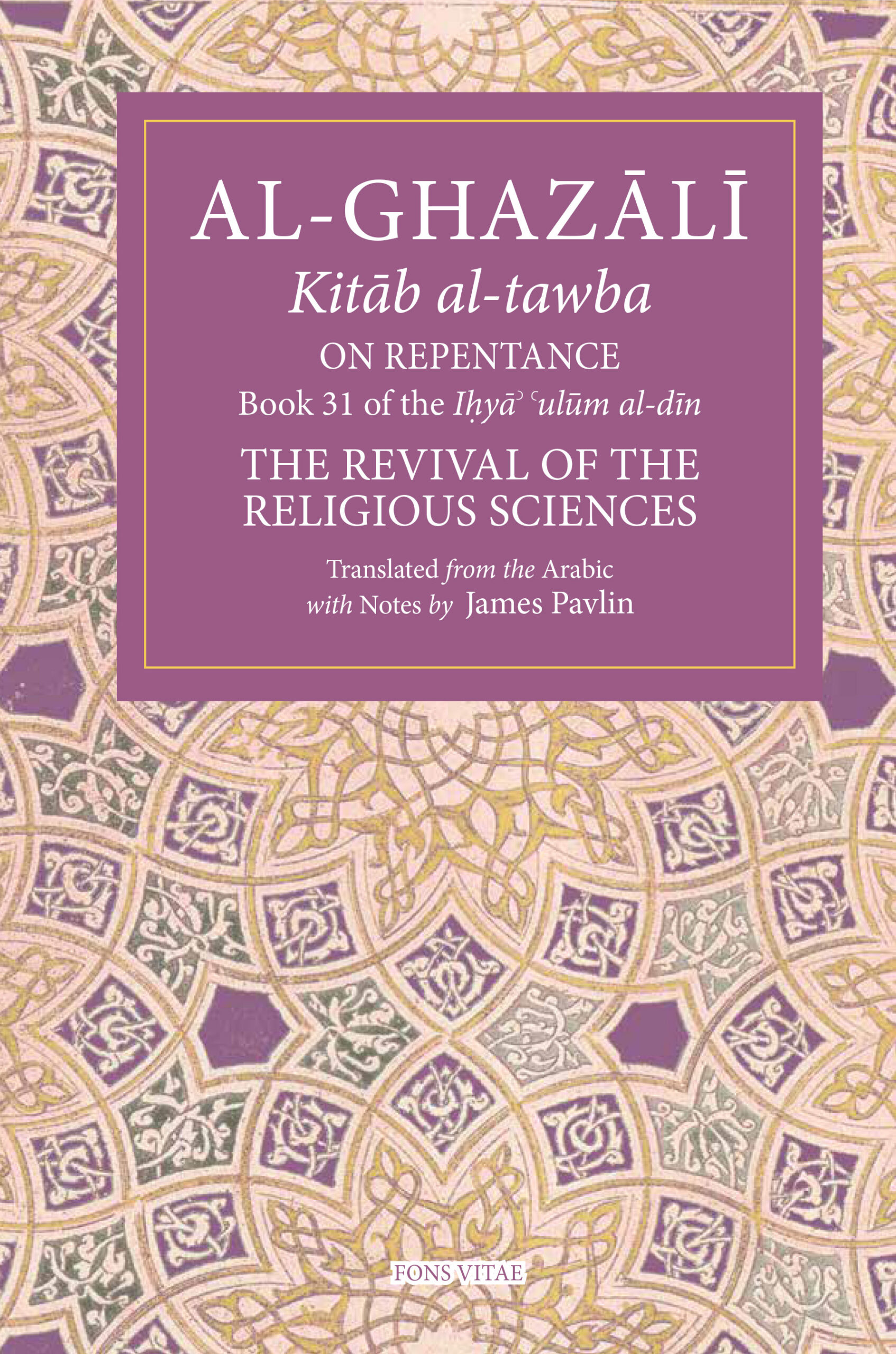
Ghazali: The Book of Repentance – Book 31

James Pavlin

n his 40-volume magnum opus, the Revival of the Religious Sciences, Ghazali devotes the first quarter to ‘Worship’, the second to ‘Customs’, and the third to ‘Perils’. He opens the final quarter, ‘Deliverance’, with the subject of Repentance (tawba), or turning around, which is the universal entry point and basis for any spiritual journey. This is both a foundational text and a mirror for the wayfarer. People already take continuous account of themselves with the passing thought, “If only I had…!”.  Ghazali counsels, “We should interrogate ourselves before being interrogated. If a person does not hold himself  accountable in this world, his accountability in the hereafter will be lengthy.”

One should not be deceived by the ephemera of this world. Al-Ghazali builds this pivotal volume on four pillars: the essence of repentance; that which requires it with a division of major and minor sins explained in detail; the conditions for accomplishing repentance; and the remedy for those who consciously persist in transgressions—including the reasons they continue to do so. Small habitual sins, he warns, weigh upon the Heart; he offers concrete ways to alter our natural disposition for delay. Like poison, sin must be gotten out at once. The accrual of even small good deeds is of significant consequence. He poses the question that unsettles every reader: if you had but one hour remaining, what would you do? For the serious seeker of today, this classic work provides a structure which supports and encourages self-assessment, making this an invaluable practical guide.

To read a sample of the book, Click here

  • PDF, Paperback, Reflowable ePUB
  • 9798896400172
  • 216

Product Description

Contents:

Editor’s Note
Biography of Imām al-Ghazālī
About the Revival of the Religious Sciences xix
Translator’s Preface
The Book of Repentance
[Author’s Introduction] 

Chapter 1 The first pillar:
Concerning the essence of repentance [13]
    Elucidation of the reality of repentance and its definition [13] 
    Elucidation of the requirements of repentance and its virtue [17] 
    Elucidation that the obligation of repentance is immediate [28]
    Elucidation that the obligation of repentance is universal for all people and conditions [33]
    Elucidation that when the conditions of repentance have accumulated then it is accepted without doubt [46] 

Chapter 2 [57] The second pillar:
    Concerning that which requires repentance, and these are the minor and major sins [57] 
    Elucidation of the divisions of sins relative to the attributes of the servant [57] 
    Elucidation of how the distribution of higher and lower levels in the hereafter are based on good deeds and evil deeds in this world [79]
    Elucidation of what increases the minor sins [109] 

Chapter 3 [117] The third pillar:
    Concerning the completion of repentance, its conditions, and its continuance until the end of life [117] 
    Elucidation of the divisions of the servants in the continuity of repentance [147] 
    Elucidation of what is appropriate for the penitent to hasten to if sin comes over him, either from intention and overwhelming desire or from committing it by a sudden decision [157]

Chapter 4 [168] The fourth pillar:
    Concerning the remedy of repentance and the path of treatment to untie the knot of persistence [in sin] [168]

Bibliography
Indices
    Index of Qurʾānic Verses
    Index of Ḥadīth
    Index of People and Places 
    Subject Index
About the Translator