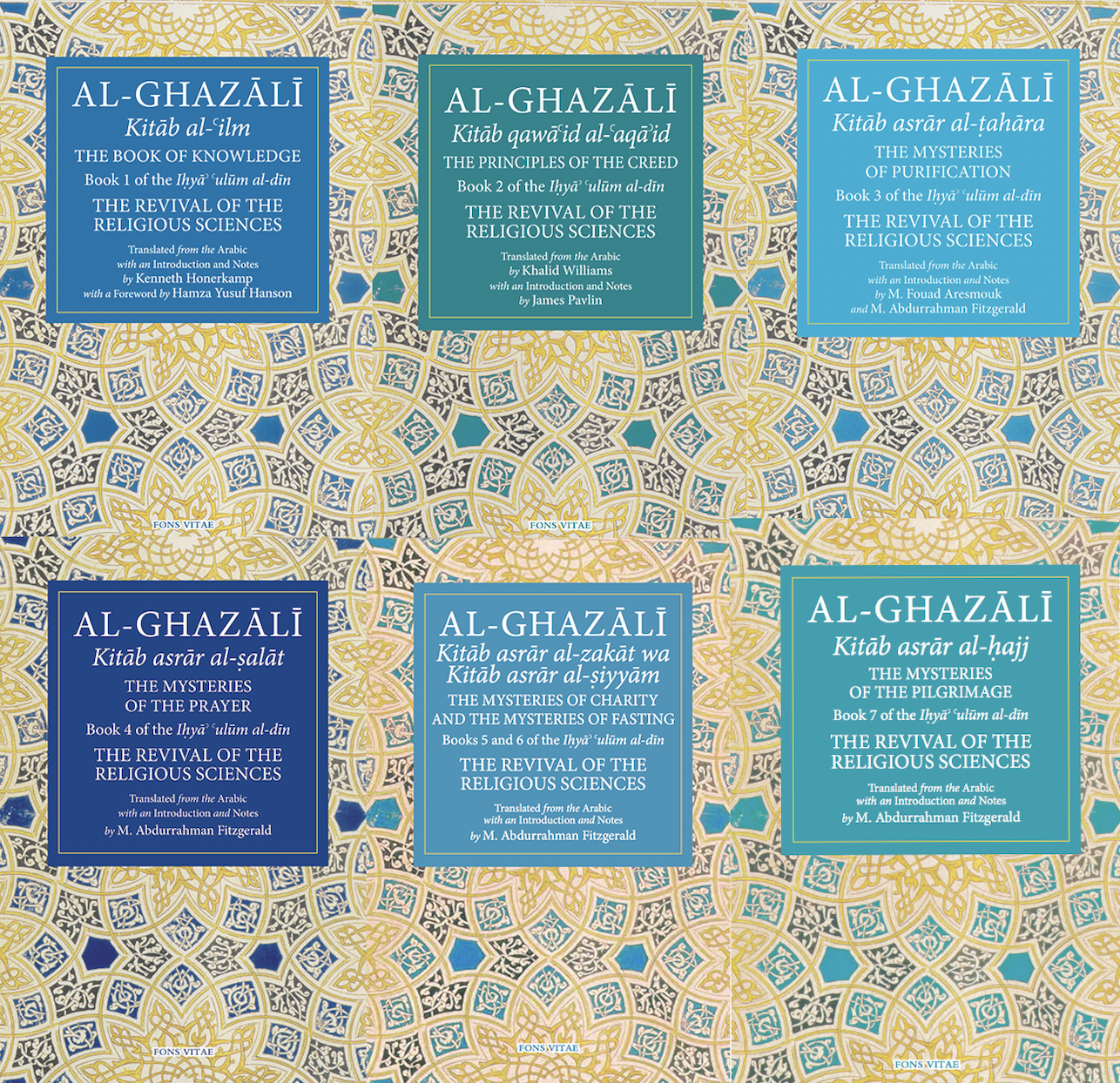
Click on any title below for details about that book on our website.
Book 1 – The Book of Knowledge (Kitab al-ilm) is the foundation of the forty books of the Revival of the Religious Sciences (Ihya ulum al-din).
Book 2 – In the Principles of the Creed, (Kitab qawaid al-aqaid) Abu Hamid al-Ghazali explains the fundamental beliefs of Islam, those that concern faith in God, His revelation, His messengers, and the hereafter.
Book 3 –The Mysteries of Purification (Kitāb asrār al-ṭahāra). In this book Abū Ḥāmid al-Ghazālī explains the fundamentals of the purification that is necessary in order to perform the five daily prayers.
Book 4 – In the Mysteries of the Prayer and Its Important Elements (Kitāb asrār al-ṣalāt wa-muhimātiha), Abū Ḥāmid al-Ghazālī explains the inner and outer meanings of the prayer, a central practice for Muslims. This is one of five books that deal with the inner dimensions of Islamic worship; books 3, 5, 6, and 7 address purification, zakāt, fasting, and pilgrimage, respectively.
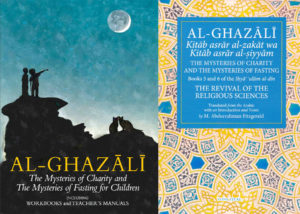
Books 5 & 6 – In the Mysteries of Charity and Mysteries of Fasting, Abū Ḥāmid al-Ghazālī explains the inner and outer meanings of charity and fasting, two pillars of worship for Muslims.
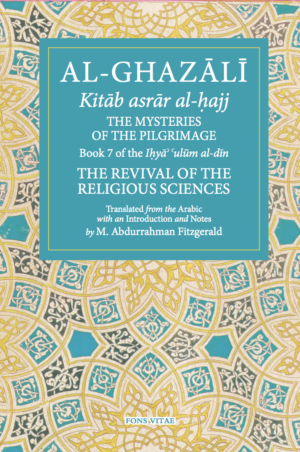
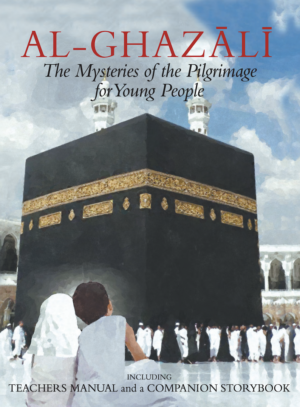
Book 7 – In the Mysteries of the Pilgrimage, Abū Ḥāmid al-Ghazālī discusses the fundamentals of the pilgrimage, including its pillars, preconditions, and obligations.
Book 10: The Arrangement of the Litanies and the Exposition of the Night Vigil In this volume, al-Ghazali makes clear that were humankind but more acutely aware of life’s extreme brevity and the actual urgency of being constantly present to God, each day in our lives would necessarily be punctuated by a near continuous recitation of sacred litanies. At the same time, however, he highlights the mercy inherent in the division of the twenty-four hour day which allows people to engage in worship in diverse ways, even as they at-tend to work, study, families, other duties, and sleep.
Book 16: In The Proprieties of Retreat, al-Ghazali addresses the question of whether it is better to engage in social intercourse (al-mukhalata) or remove oneself from society to focus on perfecting one’s relation to God.
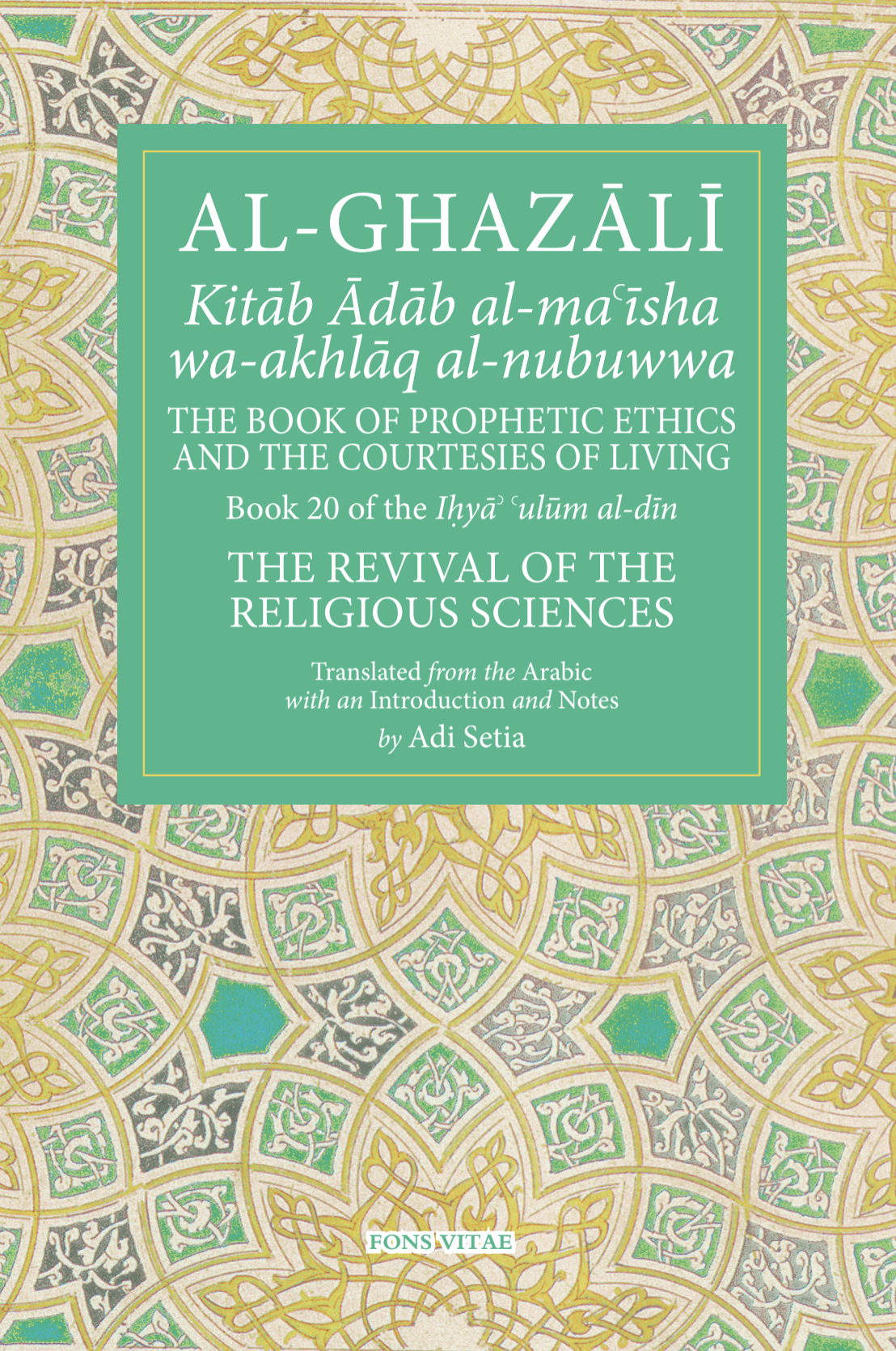
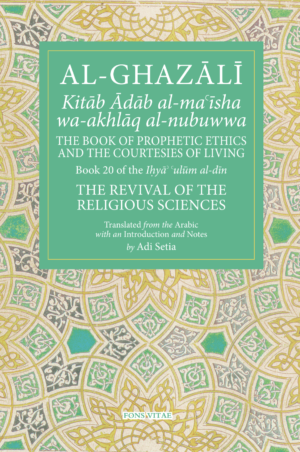
Book 20 In the Book of Prophetic Ethics and the Courtesies of Living, Abu hamid al-Ghazali gives a full account of the customs and character of the Messenger of God, Muhammad. It is not a biography of Muhammad (peace and blessing of God be upon him) but a roadmap for those who want to strengthen their faith, increase their knowledge and deepen their understanding of the second part of the testimony of faith, namely the first pillar of Islam.
Book 21 – The Marvels of the Heart. Each heart, according to this traditional wisdom accumulated over centuries of spiritual practice and experience, possesses four qualities: predatory, animal, demonic, and divine. The latter represents our true origin and potential, and by use of the intelligence and spiritual practices enabled by God’s grace, we may restore equilibrium to our inner core. As the Koran says: ‘By the remembrance of God do hearts find peace.
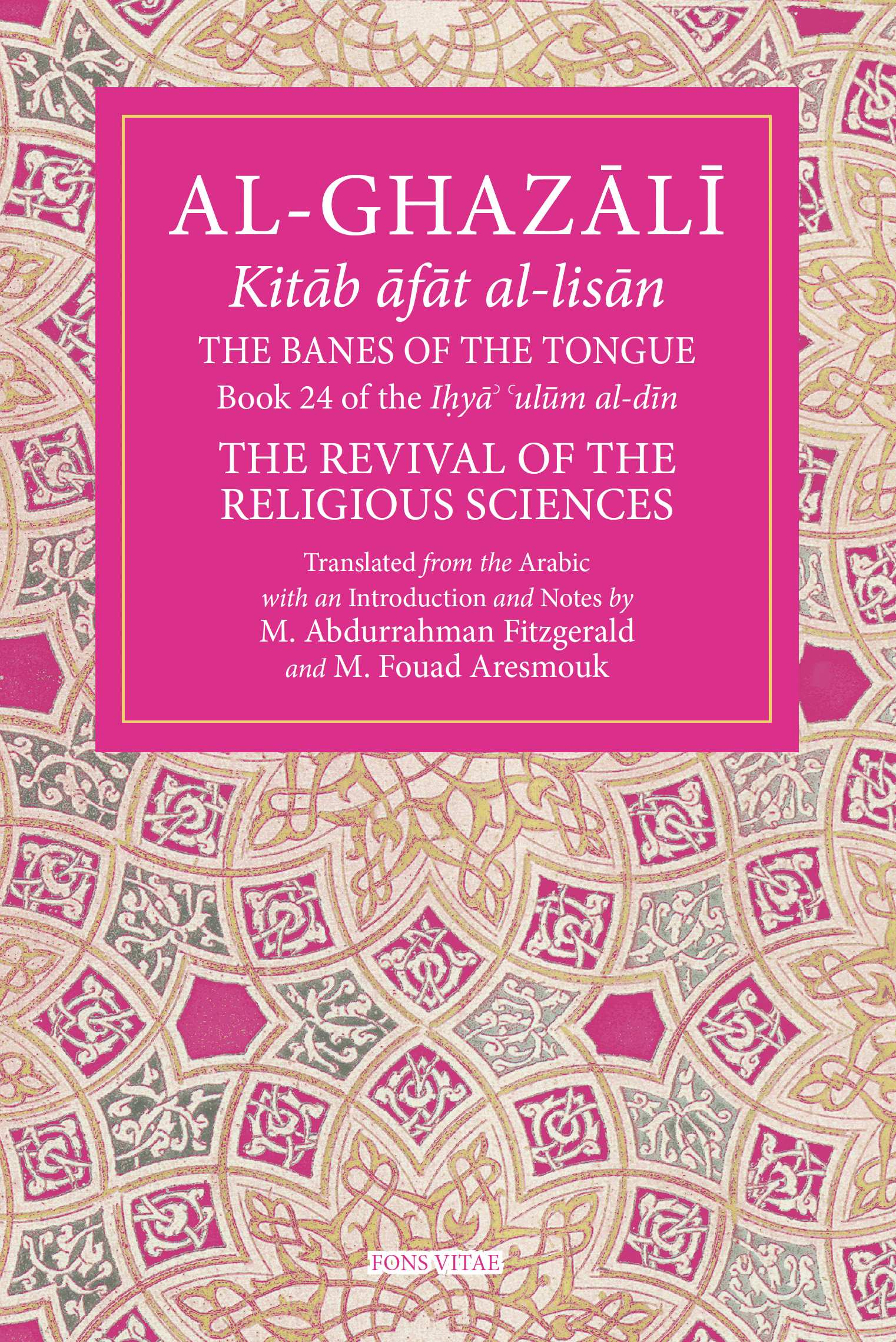
Book 24 – In the Banes of the Tongue, Imām al-Ghazālī divides up the banes, or defects, of the tongue from the least to the most offensive. These include seemingly mundane acts, such as speaking about what is not our concern or pretentious speech, to more serious defects such as using obscene words, cursing, ridiculing others, lying, and gossip. Al-Ghazālī carefully defines each defect and analyzes both its psychological and spiritual dimensions.
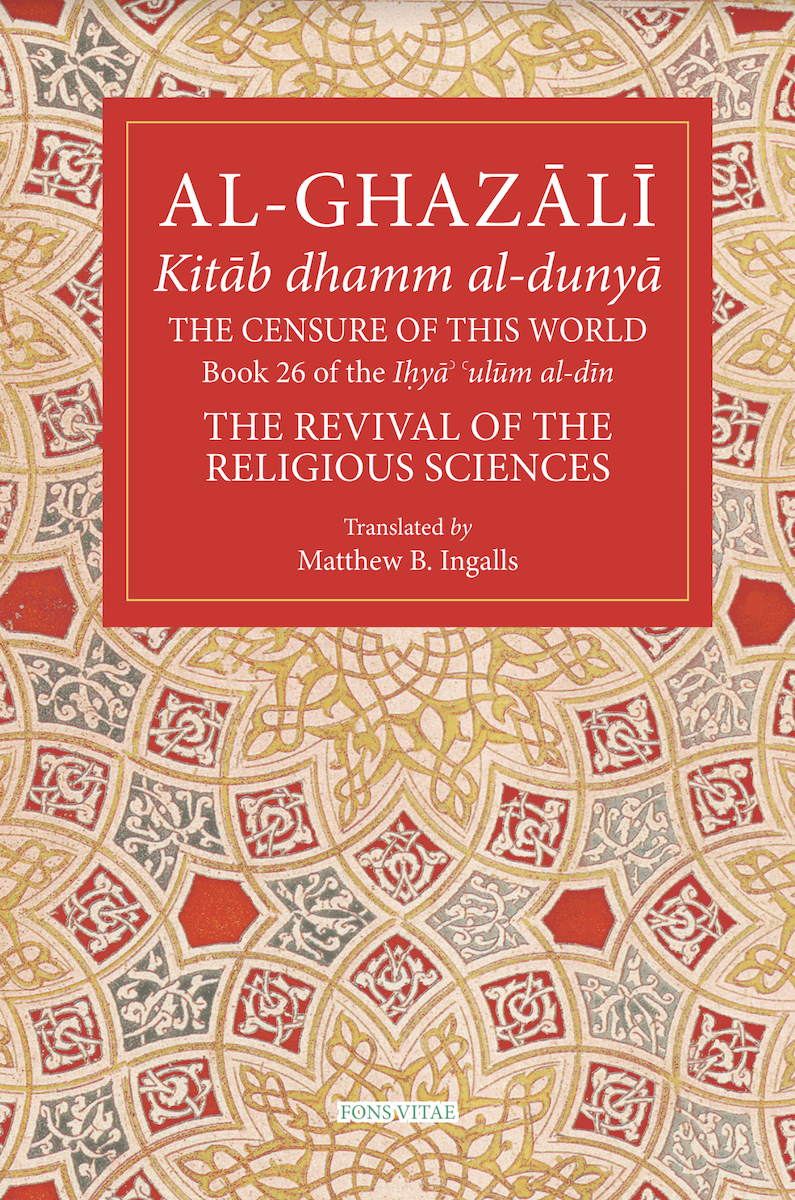
Book 26: The Censure of This World This book covers the broadest topic; namely this world, while the following books delve into specific traits. Al-Ghazālī approaches the topic of this world from the widest possible perspective; that being, the extent of our existence in this world relative to pre-eternity and the eternity of the hereafter. Although our lives here are minute in terms of existence, this time and our choices are crucial to our fate in the next life.
Book 27: The Censure of Wealth and Miserliness. Al-Ghazali writes that wealth is the principal pillar of this world, and the more wealth we have, the more engaged we become with the world. In this volume, al-Ghazali explains the subtle connection between one’s inner relationship with wealth and one’s outward actions and lifestyle.
Book 35: Faith in Divine Unity and Trust in Divine Providence: It is fair to say that the “Book of Faith in Divine Unity and Trust in Divine Providence ” plays an axial role in Ghazali’s celebrated compendium, the Ihya Ulum al-din. What is at issue is not Divine Unity itself, but the implications for the community arising from the idea that everything comes from God and that “there is no agent but God.”
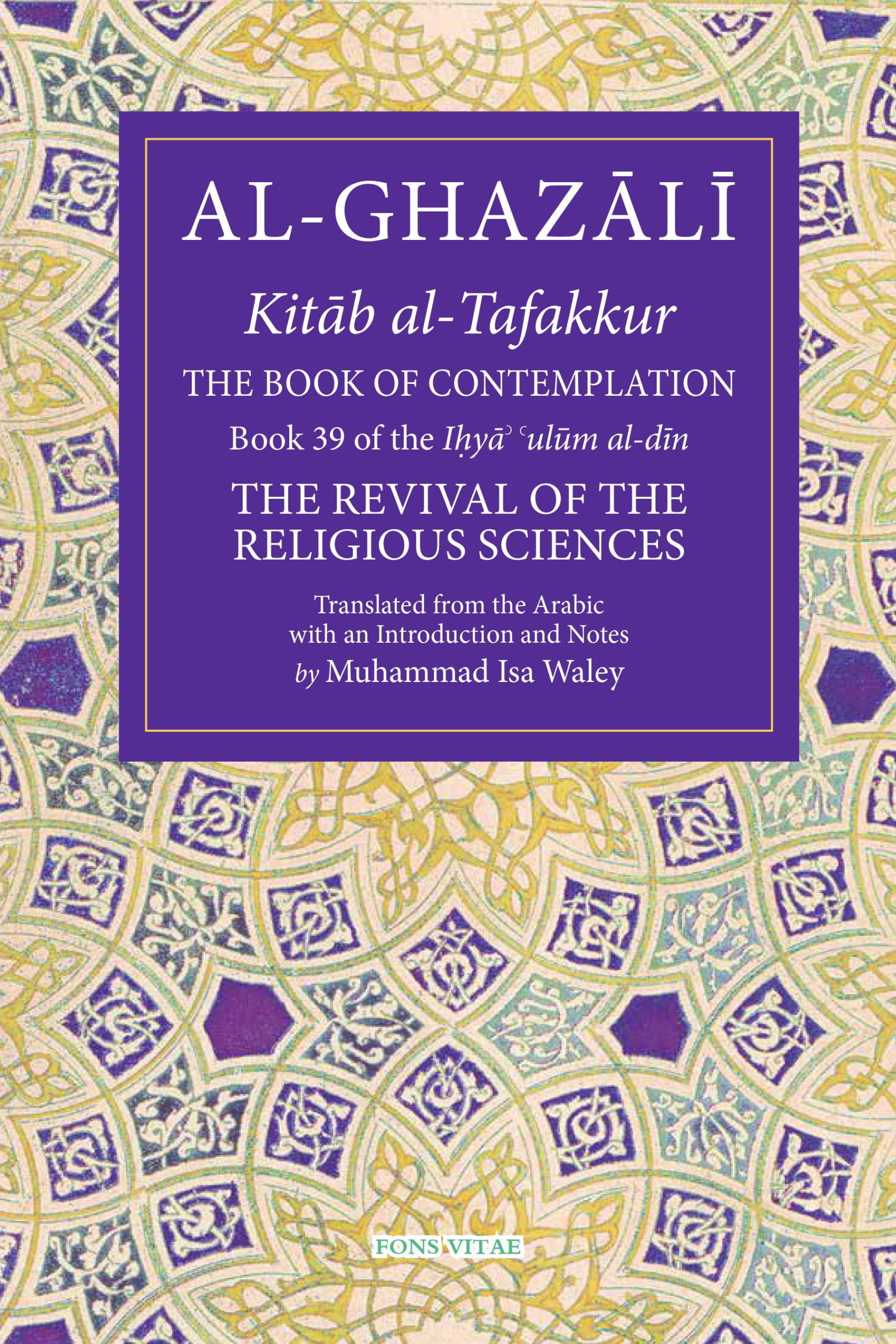
Book 39: In the Book of Contemplation Ghazali explains the nature and importance of contemplation, or reflection, as an act that enriches the thinking person with increased knowledge of, and wonder at, the Creator and His creation.